Space Lens Simulator
Space Lens Simulator
Space Lens Simulator is an interactive scientific prototype exploring an unconventional question: could enormous fluid-based optics constructed in space help us study distant stars and potentially search for signs of life on nearby exoplanets?
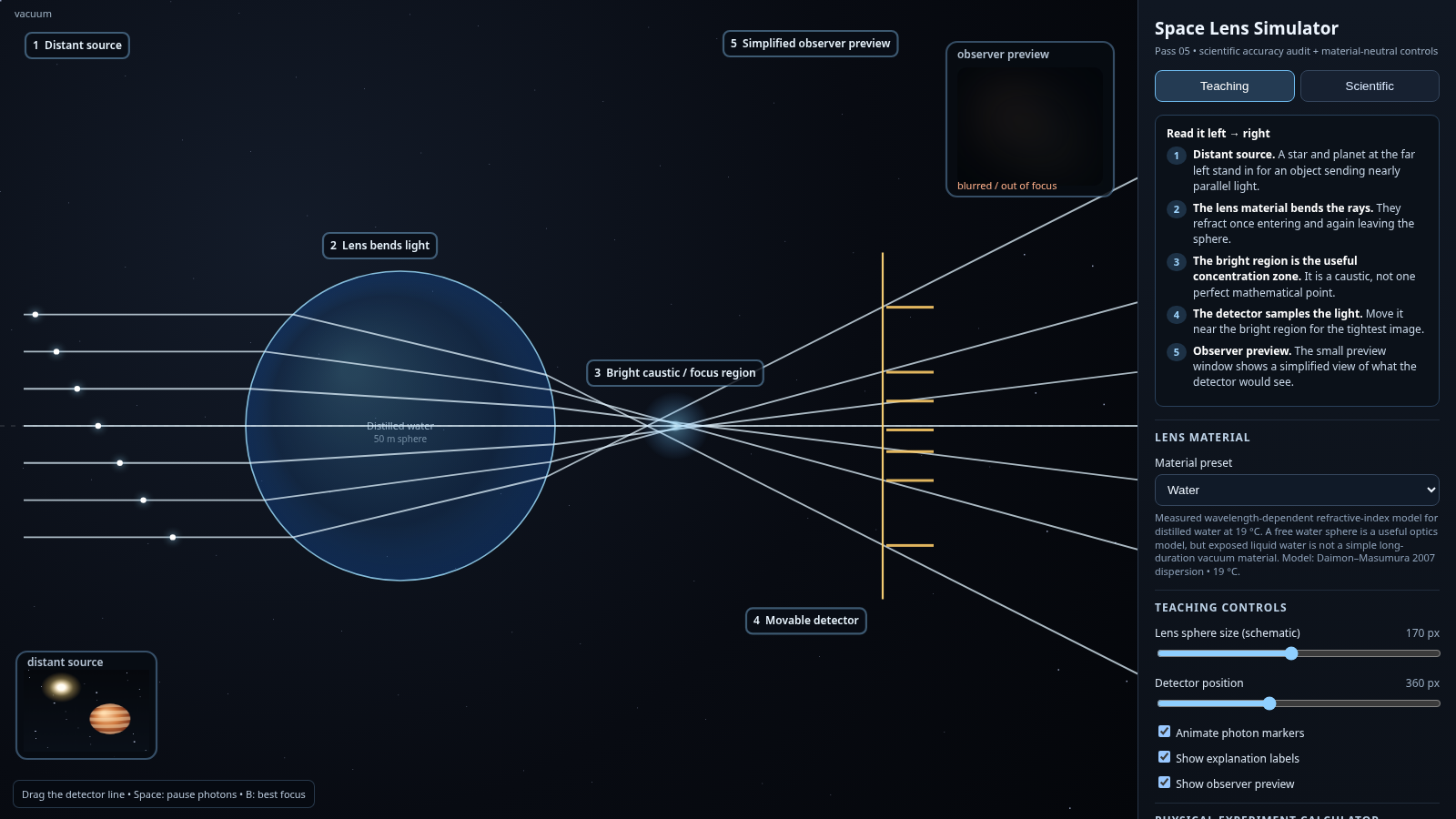
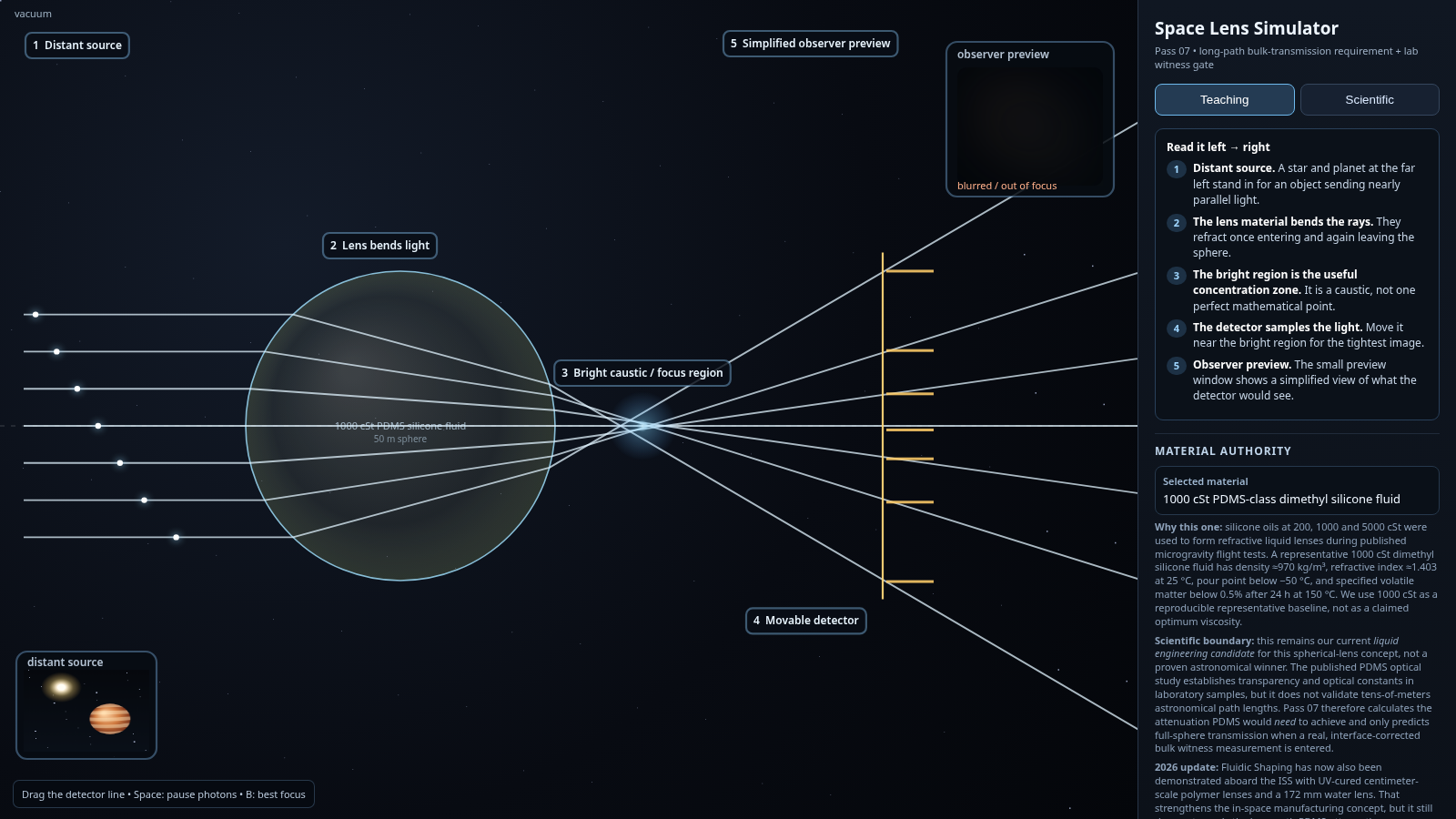
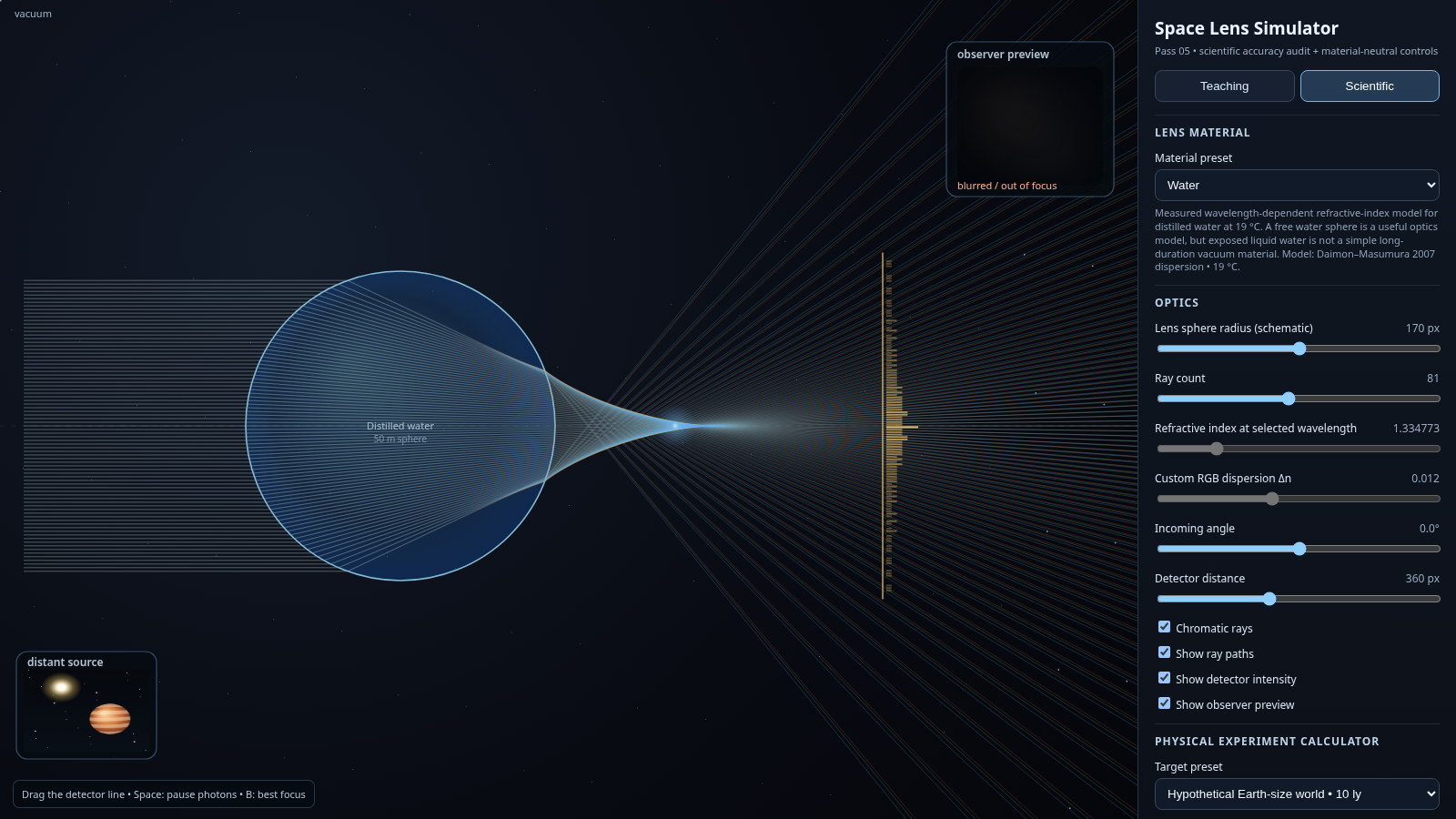
The project began with a simple idea—a large transparent sphere suspended in microgravity—and gradually developed into a physics-based optics laboratory. The simulator traces light through spherical lenses using refraction, shows the real three-dimensional focus and caustic region, measures aberration, calculates detector placement, and estimates how lens diameter, wavelength, material properties, and astronomical distance affect what could actually be observed.
The current research model uses PDMS-class silicone optical fluid as a candidate material and Proxima Centauri, our nearest neighboring star system, as a practical test target. Because Proxima is more than four light-years away, its incoming light behaves essentially like a parallel wavefront across a telescope-sized optic. The 3D simulator lets users watch those rays enter the lens, bend at each surface, converge toward the best-focus region, and spread again beyond it.
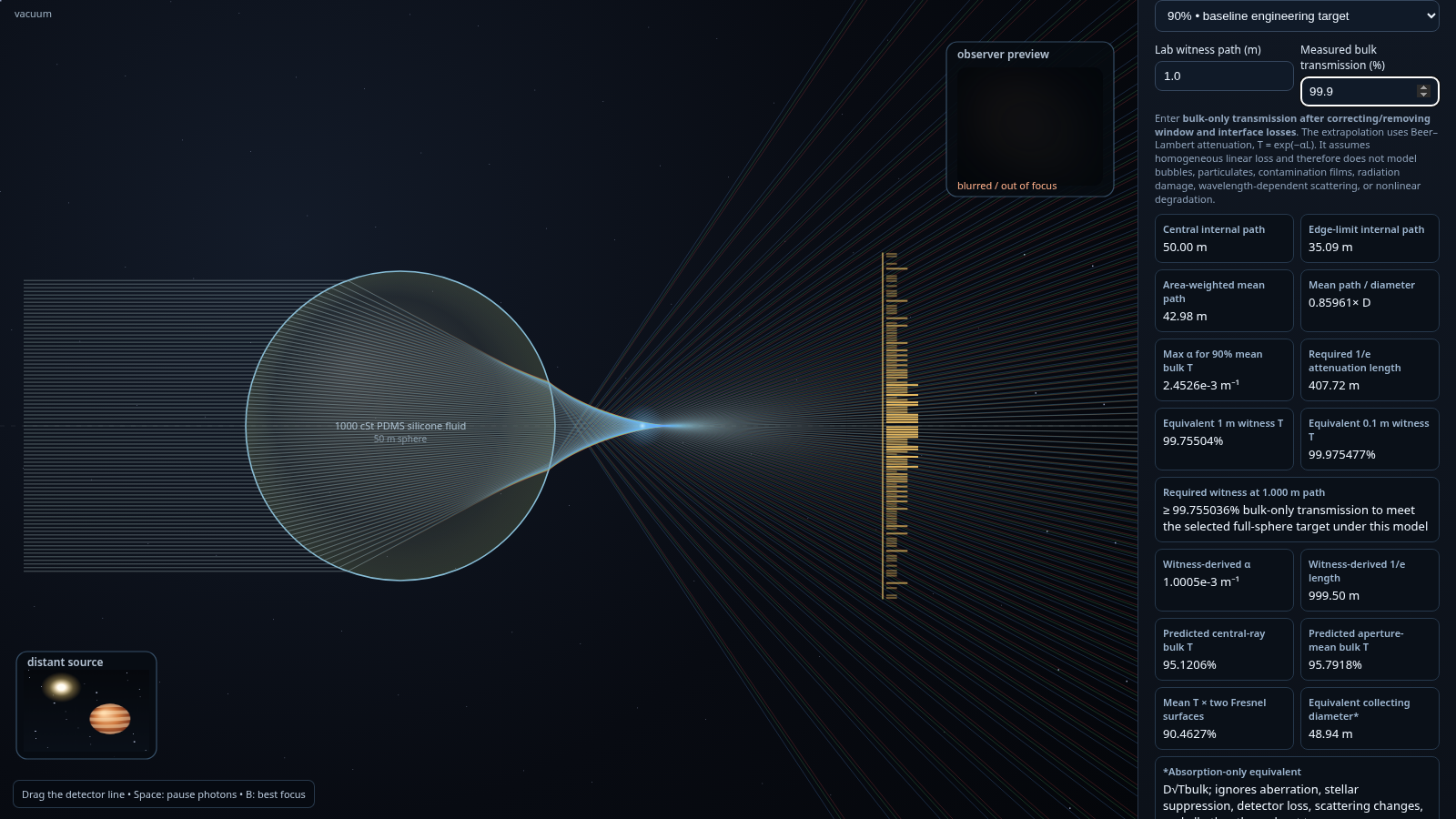
The project also examines the engineering problems that appear once these ideas are scaled up. A completely filled 50-meter spherical lens would contain tens of thousands of tonnes of optical fluid, so the simulator investigates not only focusing performance but also material path length, transmission losses, aperture size, geometric aberration, diffraction limits, and eventual alternatives such as thin or hollow optical structures.
One of the project's most important principles is that favorable answers are not assumed. Unknown quantities—such as long-distance transmission through many meters of optical fluid—are treated as unresolved experimental requirements rather than invented values. The simulator can therefore help identify what future laboratory experiments would actually need to measure before an idea could be considered viable.
Current investigations include:
-
Three-dimensional ray tracing through spherical space lenses
-
Focusing light from Proxima Centauri
-
Movable detector planes and best-focus calculations
-
Spherical aberration and usable-aperture tradeoffs
-
Wavelength-dependent refraction
-
Bulk optical transmission requirements
-
Physical lens mass and construction scale
-
Exoplanet angular-size and star-separation calculations
-
Hollow and thin-shell lens concepts
-
Future comparison with fluid mirrors and shaped optical membranes
Space Lens Simulator is not a claim that a giant spherical telescope can currently be built. It is an experimental design environment for asking what such a system would require, where the physics helps us, where it works against us, and whether a more practical space-built optical structure can emerge from the investigation.
Absolutely. Here’s a clean Data References section you can place directly under the project description.
Data References
NASA FLUTE — Fluidic Telescope Supports the discussion of large space-built fluidic optics, including NASA’s proposed 50-meter-class liquid primary mirror and fluidic shaping in microgravity. (NASA) https://www.nasa.gov/science-research/astrophysics/what-is-the-fluidic-telescope/ https://www.nasa.gov/directorates/stmd/niac/niac-studies/fluidic-telescope-flute-enabling-the-next-generation-of-large-space-observatories-2/
NASA FLUTE Technical Report More detailed technical background on the 50 m fluidic telescope concept and its large, unsegmented liquid primary mirror. (NASA Technical Reports Server) https://ntrs.nasa.gov/api/citations/20240008187/downloads/FLUTE_2024_07_19.pdf
Fluidic Shaping and Liquid Lenses in Microgravity — 2023 Primary research paper describing the creation and optical measurement of more than 20 liquid lenses during parabolic microgravity flights. (Nature) https://www.nature.com/articles/s41526-023-00309-9
In-Space Manufacturing of Optical Lenses — 2026 ISS research demonstrating UV-cured polymer optics and a 172 mm water lens with basic optical functionality. (Nature) https://www.nature.com/articles/s41526-026-00629-6
Liquid PDMS Optical Properties Primary measurement paper covering liquid PDMS optical properties from 191 to 1688 nm, including wavelength-dependent refractive behavior. This is one of the key sources behind our PDMS optical model. (AIP Publishing) https://pubs.aip.org/avs/sss/article/25/2/026001/366720/Polydimethylsiloxane-Optical-properties-from-191
Representative 1000 cSt PDMS / Dimethyl Silicone Fluid Properties Manufacturer data for KF-96-1000cs gives 1000 cSt viscosity, specific gravity 0.970, and refractive index 1.403 at 25 °C. These are representative engineering values used by the simulator, not proof that this formulation is space-qualified. (Shinetsu Silicone) https://www.shinetsusilicone-global.com/products/type/oil/detail/search/straight.shtml
Proxima Centauri Distance — NASA NASA lists Proxima Centauri at approximately 4.25 light-years, supporting the simulator’s treatment of its incoming wavefront as effectively parallel across a telescope-scale aperture. (Imagine the Universe) https://imagine.gsfc.nasa.gov/features/cosmic/nearest_star_info.html
Proxima Centauri b — NASA Exoplanet Catalog Current NASA catalog data for Proxima b, including its approximate mass, orbital period, and orbital radius. This will be useful when we add the planet as an off-axis source. (NASA Science) https://science.nasa.gov/exoplanet-catalog/proxima-centauri-b/
NASA Exoplanet Direct-Imaging Technology Explains why Earth-like exoplanet imaging is dominated by extremely high star/planet contrast and starlight suppression. NASA notes that Earth-like planets can be millions to billions of times fainter than their stars depending on wavelength. (NASA Science) https://science.nasa.gov/astrophysics/programs/exep/technology/
Habitable Worlds Observatory NASA’s current future-observatory direction for directly imaging and spectroscopically studying Earth-like planets, targeting approximately 10⁻¹⁰ high-contrast performance. (NASA Science) https://science.nasa.gov/astrophysics/programs/cosmic-origins/community/hwo-sig/
Simulator-derived quantities
Some values in Space Lens Simulator are not copied from a source; they are calculated from standard optics using the sourced input data above. These include:
-
Snell-law ray trajectories
-
best-focus position
-
spherical aberration
-
geometric RMS spot size
-
diffraction/Airy estimates
-
angular size
-
projected image size
-
lens volume and mass
-
path length through the optic
-
Fresnel losses
-
Beer–Lambert transmission requirements
-
Proxima wavefront-curvature estimates
Those should be labeled calculated by the simulator, rather than presented as externally measured data.
One especially important disclaimer for readers is:
That distinction is what keeps the project scientifically defensible rather than making the simulator look more certain than the available data warrants.Absolutely. Here’s a clean Data References section you can place directly under the project description.Data ReferencesNASA FLUTE — Fluidic Telescope Supports the discussion of large space-built fluidic optics, including NASA’s proposed 50-meter-class liquid primary mirror and fluidic shaping in microgravity. (NASA) https://www.nasa.gov/science-research/astrophysics/what-is-the-fluidic-telescope/ https://www.nasa.gov/directorates/stmd/niac/niac-studies/fluidic-telescope-flute-enabling-the-next-generation-of-large-space-observatories-2/NASA FLUTE Technical Report More detailed technical background on the 50 m fluidic telescope concept and its large, unsegmented liquid primary mirror. (NASA Technical Reports Server) https://ntrs.nasa.gov/api/citations/20240008187/downloads/FLUTE_2024_07_19.pdfFluidic Shaping and Liquid Lenses in Microgravity — 2023 Primary research paper describing the creation and optical measurement of more than 20 liquid lenses during parabolic microgravity flights. (Nature) https://www.nature.com/articles/s41526-023-00309-9In-Space Manufacturing of Optical Lenses — 2026 ISS research demonstrating UV-cured polymer optics and a 172 mm water lens with basic optical functionality. (Nature) https://www.nature.com/articles/s41526-026-00629-6Liquid PDMS Optical Properties Primary measurement paper covering liquid PDMS optical properties from 191 to 1688 nm, including wavelength-dependent refractive behavior. This is one of the key sources behind our PDMS optical model. (AIP Publishing) https://pubs.aip.org/avs/sss/article/25/2/026001/366720/Polydimethylsiloxane-Optical-properties-from-191Representative 1000 cSt PDMS / Dimethyl Silicone Fluid Properties Manufacturer data for KF-96-1000cs gives 1000 cSt viscosity, specific gravity 0.970, and refractive index 1.403 at 25 °C. These are representative engineering values used by the simulator, not proof that this formulation is space-qualified. (Shinetsu Silicone) https://www.shinetsusilicone-global.com/products/type/oil/detail/search/straight.shtmlProxima Centauri Distance — NASA NASA lists Proxima Centauri at approximately 4.25 light-years, supporting the simulator’s treatment of its incoming wavefront as effectively parallel across a telescope-scale aperture. (Imagine the Universe) https://imagine.gsfc.nasa.gov/features/cosmic/nearest_star_info.htmlProxima Centauri b — NASA Exoplanet Catalog Current NASA catalog data for Proxima b, including its approximate mass, orbital period, and orbital radius. This will be useful when we add the planet as an off-axis source. (NASA Science) https://science.nasa.gov/exoplanet-catalog/proxima-centauri-b/NASA Exoplanet Direct-Imaging Technology Explains why Earth-like exoplanet imaging is dominated by extremely high star/planet contrast and starlight suppression. NASA notes that Earth-like planets can be millions to billions of times fainter than their stars depending on wavelength. (NASA Science) https://science.nasa.gov/astrophysics/programs/exep/technology/Habitable Worlds Observatory NASA’s current future-observatory direction for directly imaging and spectroscopically studying Earth-like planets, targeting approximately 10⁻¹⁰ high-contrast performance. (NASA Science) https://science.nasa.gov/astrophysics/programs/cosmic-origins/community/hwo-sig/Simulator-derived quantitiesSome values in Space Lens Simulator are not copied from a source; they are calculated from standard optics using the sourced input data above. These include:Snell-law ray trajectories
best-focus position
spherical aberration
geometric RMS spot size
diffraction/Airy estimates
angular size
projected image size
lens volume and mass
path length through the optic
Fresnel losses
Beer–Lambert transmission requirements
Proxima wavefront-curvature estimatesThose should be labeled calculated by the simulator, rather than presented as externally measured data.One especially important disclaimer for readers is:The current PDMS candidate is provisional. No source presently demonstrates acceptable optical transmission through tens of meters of PDMS for this application. Long-path bulk transmission remains an unresolved experimental requirement.That distinction is what keeps the project scientifically defensible rather than making the simulator look more certain than the available data warrants.